
Organizations invest heavily in quality procedures, audits, and certifications — yet complex programs continue to experience late-stage failures, cost overruns, and governance surprises.
Executives are left with a fundamental question:
Do we truly have control over quality risk — or are we simply generating activity?
The issue is not effort.
It is governance design.
In many organizations, quality governance evolves organically rather than intentionally. Roles blur, assurance fragments, and accountability becomes implicit. As a result, quality remains operationally busy but strategically ineffective.
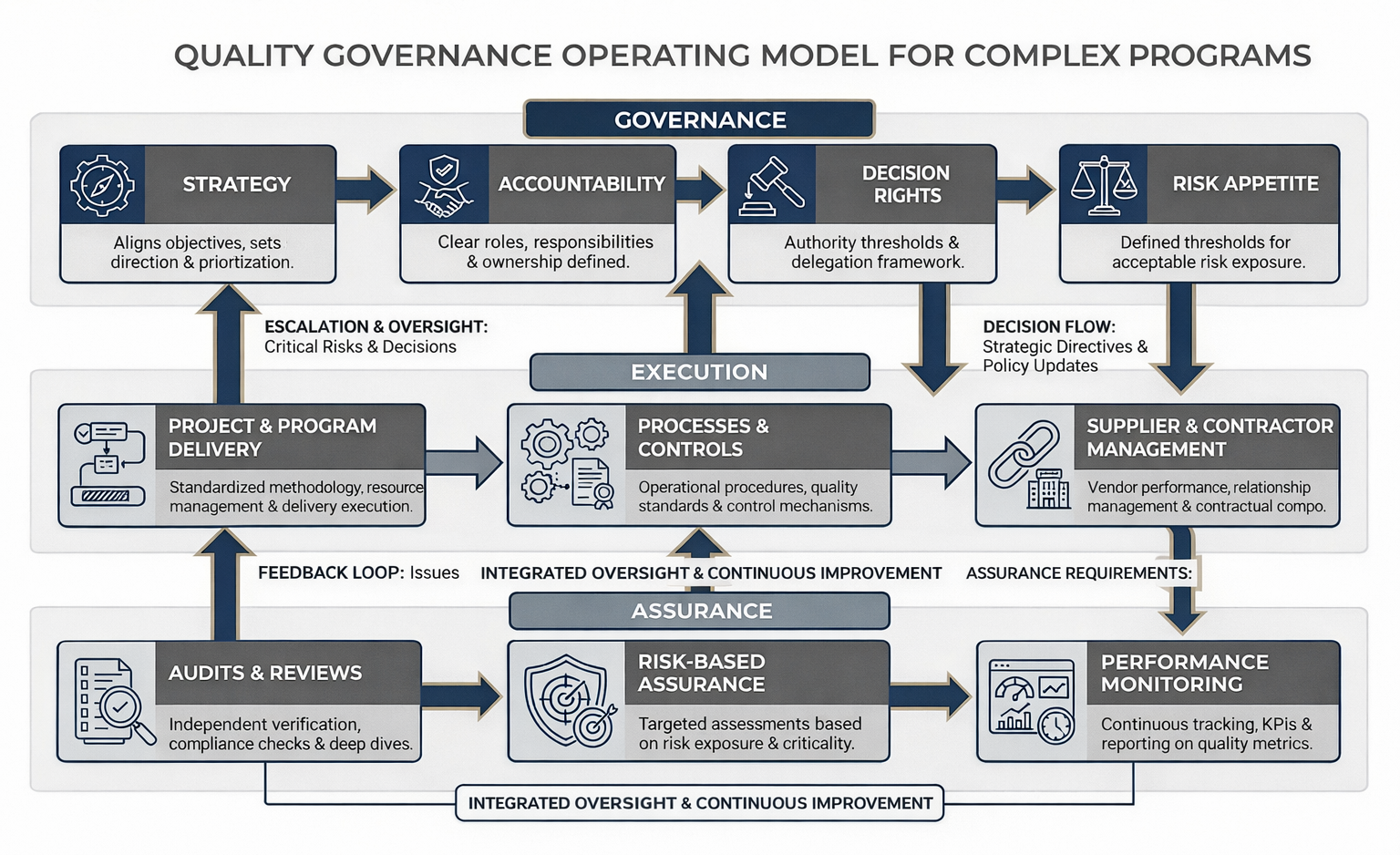
To function at scale, quality must be governed through a clear operating model — one that aligns leadership intent, risk management, assurance, and decision-making.
1. Start With Governance — Not Procedures
Effective quality governance does not begin with checklists or audit schedules. It begins with clarity on how quality is directed and controlled at each level of the organization.
A sound governance model defines:
- Who is accountable for quality decisions
- Where authority sits for risk acceptance and deviations
- How issues are escalated and resolved
- How confidence is provided to leadership
Without this structure, even well-written procedures fail to deliver control.
2. Separate Governance, Execution, and Assurance
One of the most common causes of governance failure is the lack of distinction between:
- Governance – setting direction and accountability
- Execution – delivering work to requirements
- Assurance – providing independent confidence
When these functions overlap without clarity:
- Assurance becomes enforcement
- Delivery teams resist quality oversight
- Leadership receives fragmented signals
A robust operating model keeps these roles distinct — while ensuring they remain aligned and mutually reinforcing.
3. Integrate Assurance Across the Program
In complex environments, assurance is often scattered across internal audits, external reviews, client assessments, and regulatory inspections.
An effective Quality Governance Operating Model integrates these activities into a single assurance framework by:
- Aligning assurance scope to risk priorities
- Eliminating duplication between reviews
- Providing consolidated, executive-level insight
The objective is not more audits — it is coherent assurance.
4. Apply a Risk-Based Governance Lens
Not all risks require the same level of control.
A mature governance model ensures that:
- High-risk activities receive deeper oversight
- Low-risk activities are not overburdened
- Governance intensity adjusts as conditions change
This enables quality teams to focus where failure would have the greatest impact — financially, operationally, or reputationally.
5. Design Governance for Decisions, Not Reporting
Many governance structures produce reports without driving action.
Effective models focus on:
- Clear thresholds that trigger leadership decisions
- Trend-based visibility rather than static metrics
- Escalation pathways tied to impact, not hierarchy
Executives should be able to quickly answer:
Where are we exposed, and what decision is required?
If governance does not support this, it is not functioning.
6. Embed the Model Into Leadership Rhythm
Governance only works when it is embedded into how the organization operates.
Quality governance must be visible in:
- Executive dashboards
- Program and portfolio reviews
- Risk and assurance forums
- Management review meetings
When quality governance sits alongside financial and delivery performance, it becomes part of how the business is run — not a parallel function.
Closing: From Quality Activity to Quality Control
Strong quality outcomes in complex programs are not the result of more effort — they are the result of better governance.
When a Quality Governance Operating Model is intentionally designed, risk-aligned, and embedded into leadership routines, quality shifts from reactive compliance to proactive control.
That is when organizations stop managing quality activity — and start managing quality risk.