
Quality assurance is often viewed as a defensive function — necessary for compliance, but peripheral to business performance.
Executives sign off on audits, certifications, and reviews, yet still ask a familiar question:
Is quality protecting value — or simply confirming adherence?
The issue is not the presence of quality systems.
It is how quality is positioned within the organization.
When quality is treated solely as a compliance obligation, it delivers minimal strategic value. To elevate its impact, quality assurance must be deliberately aligned with business objectives, risk exposure, and value creation.
1. Compliance Is the Baseline — Not the Objective
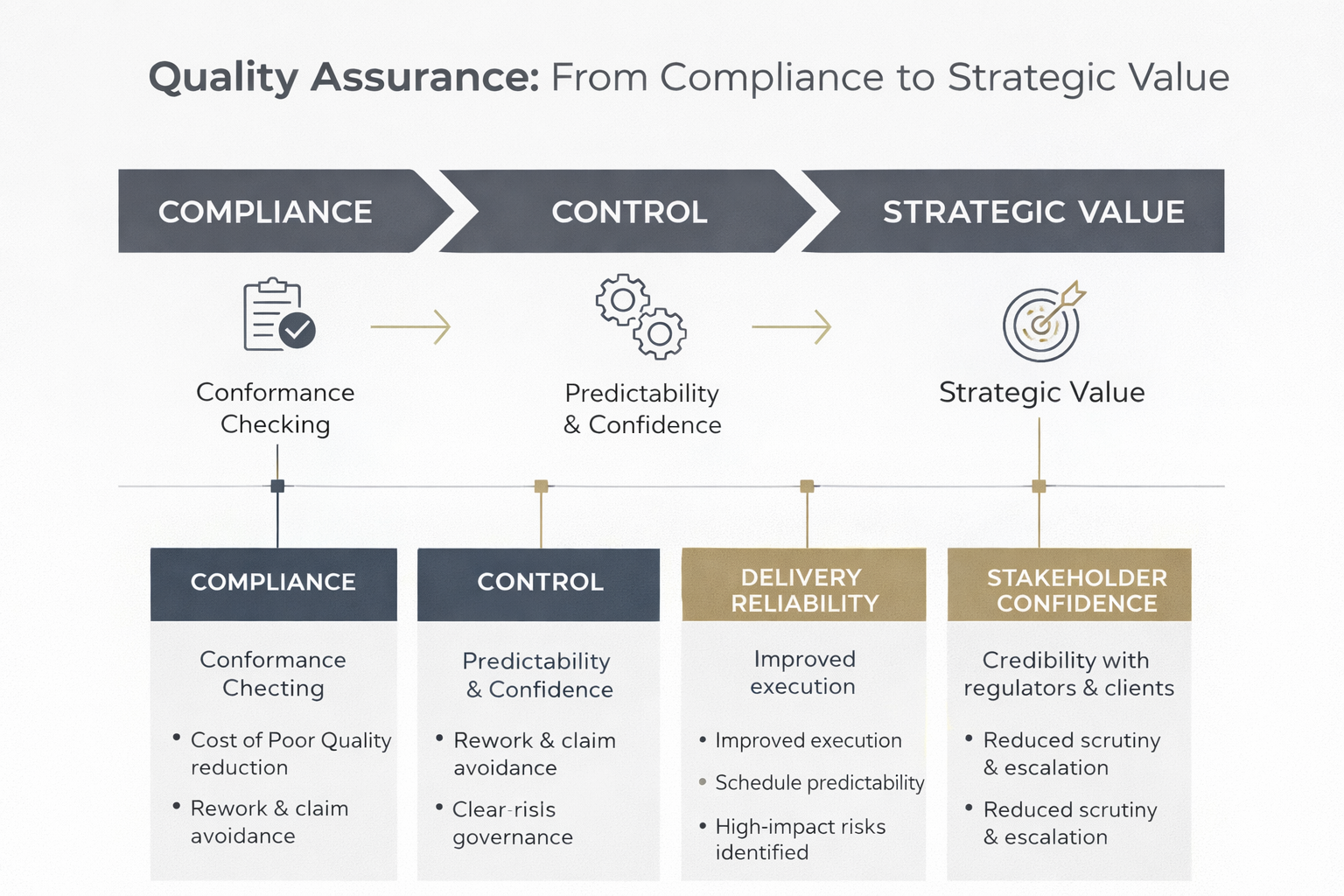
Compliance ensures minimum acceptability. Strategic value comes from control, predictability, and confidence.
Organizations that stop at compliance typically experience:
- Reactive issue management
- Late discovery of systemic risks
- Limited insight into cost and performance drivers
Quality assurance becomes valuable only when it extends beyond conformance checking and supports informed decision-making.
2. Where Quality Actually Creates Value
Strategic quality assurance contributes directly to business outcomes in four key areas:
Financial Protection
- Reduction of Cost of Poor Quality (COPQ)
- Avoidance of rework, claims, and corrective interventions
Delivery Reliability
- Improved right-first-time execution
- Greater schedule predictability and throughput
Risk Reduction
- Early identification of high-impact failure modes
- Controlled acceptance of residual risk
Stakeholder Confidence
- Credibility with regulators, clients, and partners
- Reduced scrutiny and escalation
These outcomes do not occur accidentally — they are designed.
3. Shift Assurance From Activity to Insight
Many quality functions report high volumes of activity but low strategic insight.
A value-driven assurance approach focuses on:
- Trends rather than isolated findings
- Root causes rather than symptoms
- Systemic exposure rather than individual errors
Executives do not need more reports.
They need clarity on where intervention is required.
4. Align Assurance With Business Risk
Strategic assurance is inherently risk-based.
This means:
- Assurance intensity varies based on risk exposure
- High-impact processes receive deeper scrutiny
- Low-risk areas are monitored proportionately
This alignment ensures quality resources are deployed where they generate the greatest return — not where it is easiest to measure.
5. Embed Quality Into Executive Decision Forums
Quality assurance creates value only when it informs leadership decisions.
This requires:
- Quality insights presented alongside financial and operational data
- Clear escalation thresholds tied to impact
- Action-oriented discussions, not compliance updates
When quality is embedded into executive rhythm, it becomes part of how the organization is governed.
Closing: From Compliance Function to Value Enabler
Quality assurance does not create value by existing — it creates value by shaping decisions.
When assurance is aligned to strategy, risk, and performance outcomes, quality shifts from a defensive obligation to a strategic asset.
That is when organizations stop asking whether they are compliant — and start knowing whether they are in control.