
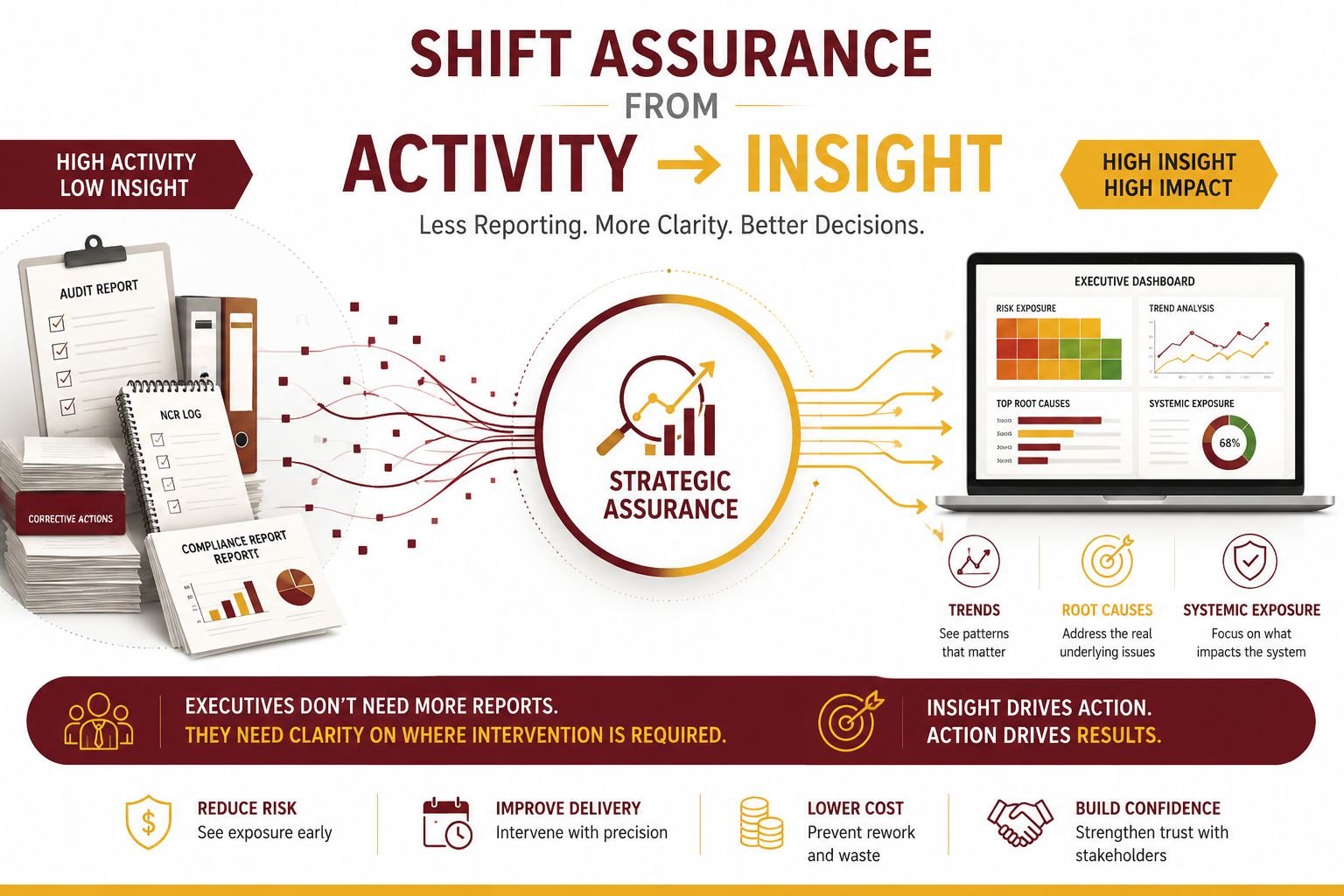
Most quality functions are busy. Few are consequential. The shift from activity-based reporting to insight-driven assurance is the defining challenge — and opportunity — of modern QA/QC leadership.
There is a question every quality leader should ask before their next executive presentation: Am I reporting what happened, or am I telling them what to do about it?
In most organisations, the honest answer is the former. Audit logs are full. NCR registers are maintained. Dashboards are populated with counts, percentages, and closure rates. Yet the boardroom remains largely untouched by quality intelligence. Decisions are made on commercial instinct rather than systemic evidence.
This is not a data problem. It is a translation problem — and solving it is the highest-value contribution a quality professional can make.
Three pivots that separate insight from activity
Value-driven assurance is not a methodology overhaul. It is a deliberate reorientation of what you measure, how you analyse it, and what you present. It rests on three foundational pivots:
Trends over findings
Not: “14 NCRs raised this quarter”
A pattern of recurring nonconformances in a single process or supplier tells a story that a count never can. Trends reveal trajectory; counts only describe a moment.
Root causes over symptoms
Not: “Deviation documented and closed”
The symptom is what failed. The root cause is why the system allowed it. Leaders must address systems, not events — or the same failures recur indefinitely.
Systemic exposure over errors
Not: “One contractor’s isolated lapse”
An individual error is correctable. A systemic gap in oversight or process design carries organisational risk that demands strategic — not tactical — response.
Busy does not mean effective
Activity metrics are seductive because they are easy to produce and easy to defend. Audits completed, corrective actions closed, inspections performed — these numbers are real, verifiable, and look like productivity.
But they answer the wrong question. They tell leadership what the quality function did. They do not tell leadership whether the organisation’s quality risk profile is improving, stable, or deteriorating.
The danger is invisible: a quality function can achieve perfect activity metrics while the organisation drifts toward a systemic failure that was never flagged — because no one aggregated the signals.
The three signals that drive decisions
Senior leaders are not auditors. They are risk allocators. When they receive a quality report, they are asking one of three questions — even if they do not articulate it:
Where is our exposure?
Which processes, suppliers, projects, or products carry quality risk that could affect safety, delivery, compliance, or reputation?
Are things getting better or worse?
Is the trend line moving in the right direction? Is our investment in quality producing measurable improvement, or are we running to stand still?
What decision is required of me?
When the quality function identifies a systemic issue, the executive needs to know: escalate, resource, restructure, or accept the risk?
A quality report that does not answer at least one of these questions has failed its audience — regardless of how thorough the underlying work was.
Practical applicationMaking the transition in your organisation
The shift from activity reporting to insight delivery does not require a new QMS or a technology investment. It requires a change in analytical discipline and communication intent.
Start with the audience. Before compiling a quality report, write down the two or three decisions an executive might make based on its contents. If you cannot name them, the report is not ready for executive consumption.
Aggregate before you present. Individual findings are raw material. Trends, pattern clusters, and root cause groupings are intelligence. Train your team to synthesise across findings rather than list them.
Lead with risk language, not quality language. Frame issues in terms of operational, financial, reputational, or safety exposure — not clause references or procedural deviations. Clause 8.4.1 of ISO 9001 does not resonate with a CFO. Supply chain integrity risk does.
Make the recommendation explicit. Quality professionals are sometimes reluctant to prescribe action for fear of overstepping. This reticence costs organisations dearly. If the data supports a recommendation, state it clearly. That is not overreach — it is the job.