
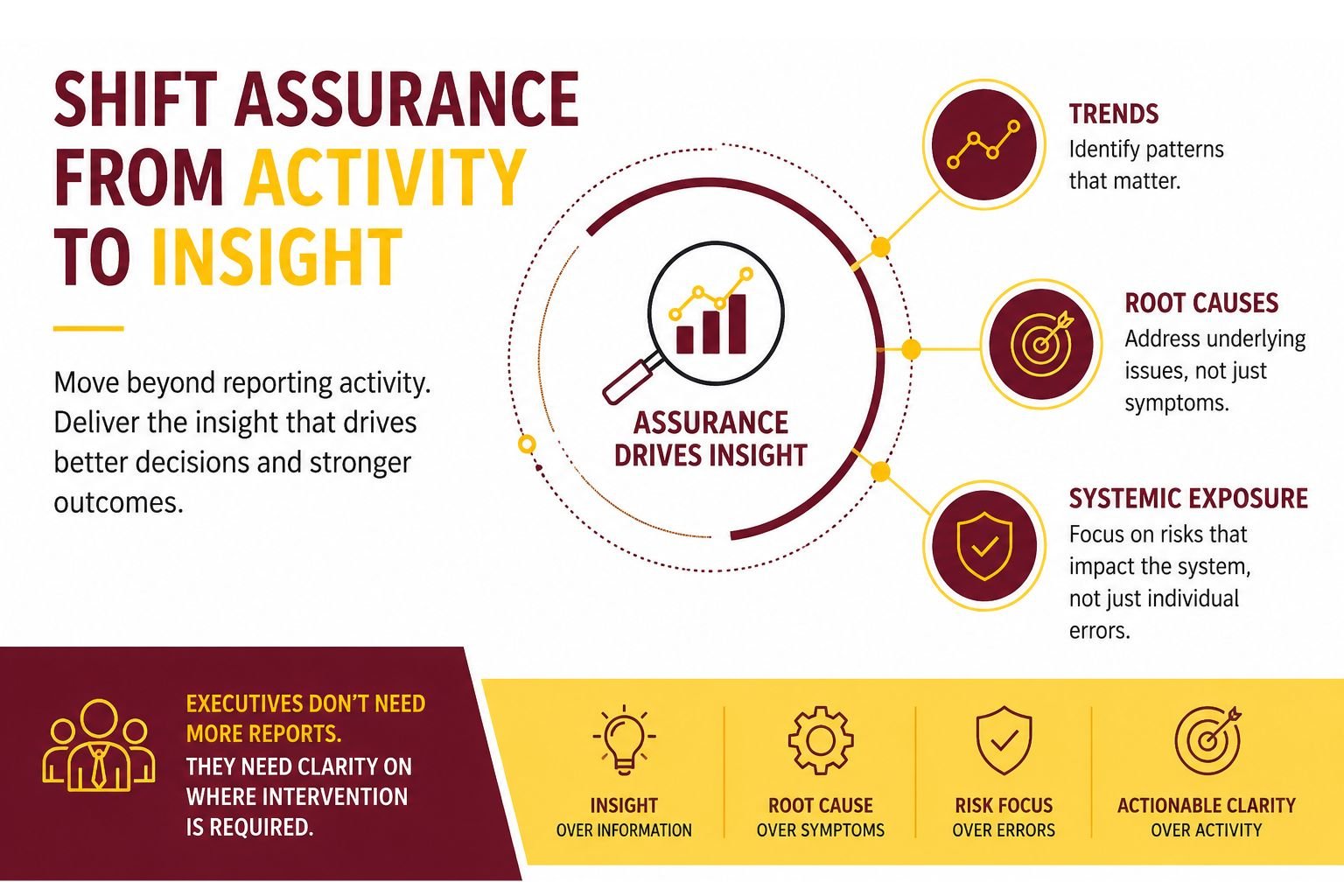
Many quality functions report high volumes of activity but low strategic insight. Audits completed. Findings logged. Reports submitted. By every measure of output, the function looks productive.
But when executives are asked whether assurance is giving them clarity, the answer is almost always no.
The problem is not effort. It is design. Quality functions have been built to produce activity — and activity is not the same as insight.
The Three Shifts That Change Everything
Trends rather than isolated findings. When the same type of failure appears across multiple business units and repeats over time, that is not a series of separate problems — it is one systemic problem. Executives can act on a trend. They cannot act on an isolated finding.
Root causes rather than symptoms. A missed approval is a symptom. The real issue may be unclear ownership, poor process design, or a resource gap. Without root cause, remediation fixes the surface and leaves the structure untouched.
Systemic exposure rather than individual errors. One poorly controlled process affecting multiple business units is a strategic risk. Framing it that way — not as a list of errors — is what gives leadership something worth acting on.
What Executives Actually Need
They are not asking for more reports. They are asking three questions: Where is the organization exposed? Where is intervention required? What is improving?
A quality function that answers those three questions with evidence earns a seat in strategic conversations. One that cannot remains a compliance obligation.
The shift does not require more resources. It requires a different question — not how much did we do, but what did we change.