
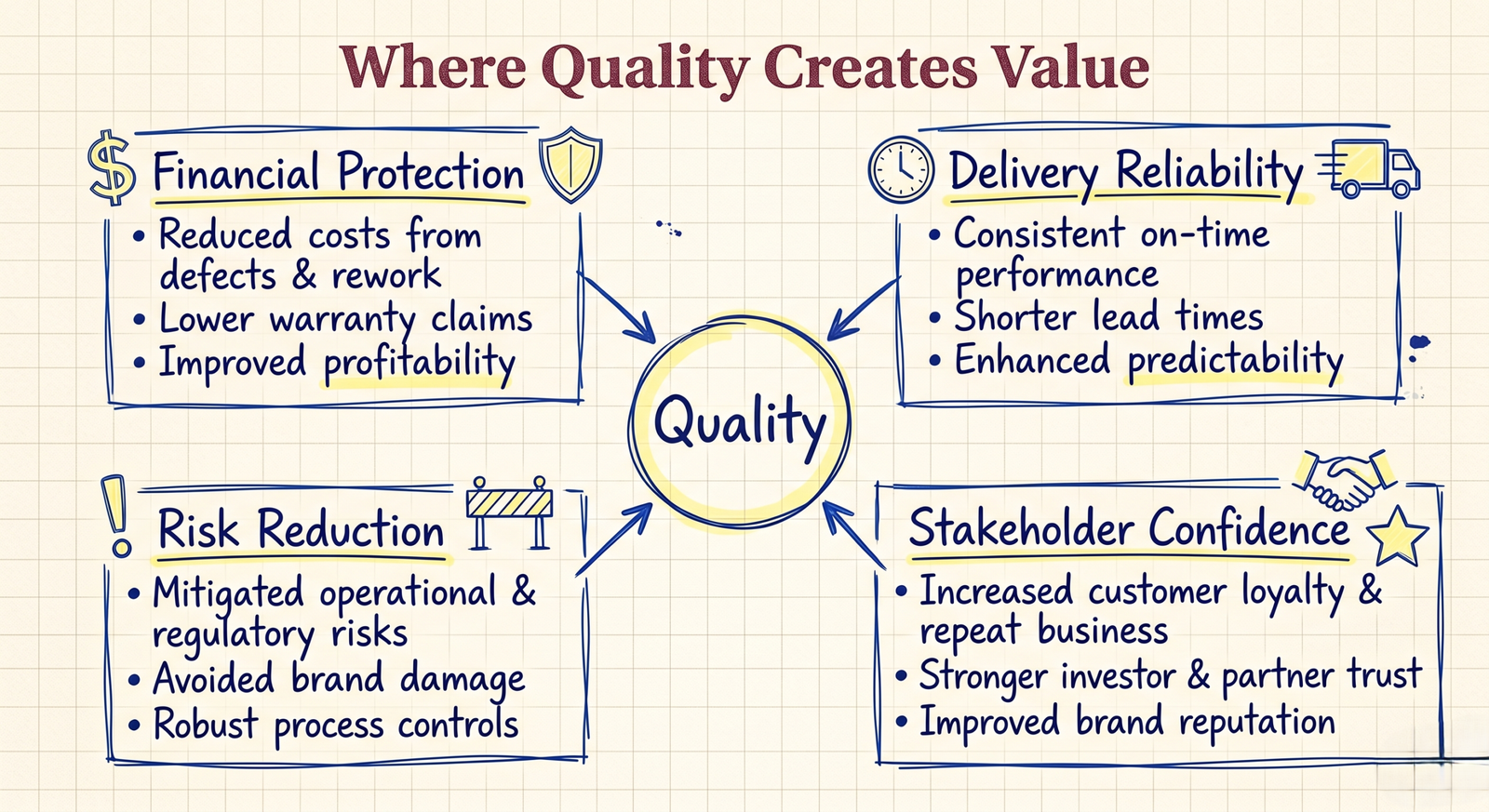
In many organizations, quality is still viewed as a compliance function—necessary, but reactive.
It verifies outcomes after decisions are made.
But leading organizations operate differently.
They treat quality as a strategic lever—one that directly influences cost, schedule, risk, and stakeholder trust.
When designed intentionally, quality does not just protect outcomes. It creates measurable business value.
1. Financial Protection: Reducing Cost of Poor Quality (COPQ)
Quality failures are rarely isolated—they cascade across cost, schedule, and stakeholder relationships.
Strategic quality assurance reduces the Cost of Poor Quality (COPQ) by:
- Preventing defects before execution
- Eliminating rework cycles
- Reducing claims and dispute exposure
- Minimizing corrective interventions
This results in predictable cost performance and protected margins, especially in large-scale infrastructure and mission-critical environments.
2. Delivery Reliability: Enabling Right-First-Time Execution
Unreliable delivery is often a symptom of reactive quality systems.
Inspection-heavy models catch issues—but too late.
Strategic quality enables right-first-time execution, leading to:
- Improved schedule predictability
- Reduced rework and late-stage corrections
- Higher throughput across project phases
- Alignment between planning and execution
Reliability is not achieved through inspection—it is achieved through process design and control.
3. Risk Reduction: Embedding Risk-Based Thinking
Risk is most dangerous when identified too late.
Strategic quality integrates risk-based thinking at the decision stage, enabling:
- Early identification of high-impact failure modes
- Integration of controls into design and execution
- Structured risk evaluation (likelihood vs consequence)
- Controlled acceptance of residual risk
This ensures that risk is not avoided blindly—but managed intentionally and aligned with business objectives.
4. Stakeholder Confidence: Building Credibility and Trust
Quality directly impacts how organizations are perceived.
Strong quality systems create:
- Confidence with regulators
- Trust with clients and partners
- Transparency in reporting and decision-making
- Reduced scrutiny and escalations
In complex environments, quality becomes a strategic credibility engine—not just an operational function.
Designed, Not Accidental
These outcomes do not happen by chance.
They are the result of intentional quality system design, including:
- Alignment with business strategy
- Integration into governance frameworks
- KPI-driven performance measurement
- Process standardization and control
- Cross-functional ownership
Conclusion: From Compliance to Competitive Advantage
Most organizations have quality systems.
Few use them strategically.
The difference lies in intent.
- Compliance-focused quality confirms outcomes
- Strategic quality shapes outcomes
When embedded correctly, quality moves from a cost center to a driver of performance, resilience, and competitive advantage.